Frequently Asked Questions About Volunteering in South Africa
Do I need to be a scuba diver to volunteer in South Africa?
No. The great white shark research in Gansbaai is primarily conducted from the surface and via cage diving, which does not require a scuba diving certification. Cage diving is used as a research methodology, allowing volunteers to make close-range observations of individual sharks and capture photo-ID images for population monitoring. If you hold a diving qualification, additional reef survey work may be available, but it is not a requirement to participate in the core shark research programme.
Is cage diving with great white sharks safe?
Yes. Cage diving with great white sharks is a well-established and tightly regulated activity in Gansbaai, which has been operating safely for decades. The cage is a rigid, open-top structure that sits at the surface, allowing participants to submerge with breathing equipment while remaining protected. The research team follows strict protocols designed around both participant safety and animal welfare. Every session is supervised by experienced field scientists.
Why are great white sharks in Gansbaai important for conservation?
Gansbaai’s Walker Bay is one of the most significant great white shark habitats remaining in the world. The cold, nutrient-rich waters support one of the largest accessible populations of this globally vulnerable species. Our research partner has been building a long-term photo-ID database of individual sharks in this area, making it one of the most comprehensive great white population datasets in existence. Understanding population size, individual movements, and habitat use is essential for developing effective conservation policy for this threatened species. Read more about our shark conservation programmes.
What has changed for great white sharks in Gansbaai in recent years?
Great white shark sightings in Walker Bay declined significantly from around 2017 following the arrival of orca predators that began targeting sharks in the area. This has had a documented impact on shark presence at traditional sites. However, great whites have been reappearing in the area as conditions shift, and the long-term population research is now more scientifically valuable than ever for understanding how this vulnerable species responds to ecological pressure. Our blog post on great whites and killer whales covers this in detail.
What is the best time of year to volunteer in South Africa?
The shark research programme runs year-round. Historically, great white shark activity in Walker Bay has been strongest during the warmer months of October to April, when seal prey is more active at the surface. The period following the orca disruptions has made seasonal patterns more variable, which is precisely why long-term monitoring by volunteers is so important. Cape Town and the Western Cape is generally pleasant year-round, with a Mediterranean climate that makes it one of the most comfortable volunteer destinations in Africa.
What will a typical day look like?
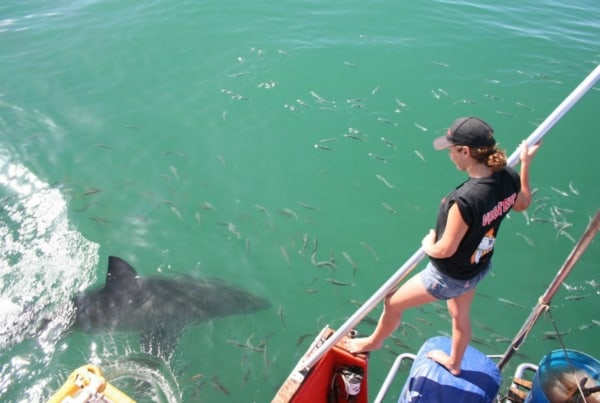
Research days involve early morning departures by boat to survey sites and traditional shark aggregation areas in Walker Bay. Volunteers observe, photograph, and record individual shark sightings, capturing dorsal fin and body marking ID shots for the population database. Surface surveys, bait deployments, and underwater cage observation sessions are all part of the research methodology. Afternoons typically involve data entry, photo-ID analysis, and species identification study. Full training is provided on arrival and all fieldwork is supervised by qualified field scientists.
How does South Africa compare to the other Marine Impact destinations?
South Africa is the most specialist of the three destinations, with research focused tightly on great white shark population monitoring. Zanzibar offers the broadest range of daily research activities including dolphin surveys, reef monitoring, and turtle conservation. Mozambique offers the most diverse megafauna encounters, with whale sharks, manta rays, and humpback whales alongside reef research. If sharks are your primary interest, South Africa is the right destination. If you want broader marine research experience, Zanzibar or Mozambique may be a better fit. Get in touch and we will help you decide.
What is the nearest airport?
The nearest major international airport is Cape Town International Airport (CPT). Gansbaai is approximately two hours’ drive from Cape Town along the N2 highway. Airport transfers to Gansbaai are arranged as part of the programme. Cape Town itself is worth extending your trip to visit, with Table Mountain, the Cape Peninsula, and Robben Island all within easy reach of the airport.